Choose and verify an export
Export is the final rendering or transfer step. Choose the output from what the recipient needs: a video to watch, an SVG still to edit at any scale, or a .scribe package that another Scribe Animator session can reopen.
Before you export
- Save the editable project or export a
.scribebackup. - Play the complete project from the beginning.
- Check every scene transition, object entrance, draw step, camera move, and audio cue.
- Confirm that the canvas aspect ratio matches the destination.
- Close unrelated dialogs and pause other CPU-heavy browser tabs or apps.
- Make a short, lower-resolution test before a long final render.
Export runs locally on the current device. Keep Scribe Animator open and in the foreground until the export finishes. Closing or reloading the page stops the render.
Pick the correct output
| Output | Use it when | What it preserves | Important limitation |
|---|---|---|---|
| Video (MP4/H.264) | The recipient only needs to watch or publish the animation | Rendered scenes, motion, camera, draw animation, and mixed audio | It is no longer editable as Scribe objects |
| Static SVG | You need a scalable still for a website, slide, or vector editor | Visible vector geometry from the current scene | No timing, audio, camera motion, or multi-scene playback |
Scribe package (.scribe) | You need an editable backup or transfer | Project data plus package assets supported by the package exporter | Reopen it in a compatible Scribe Animator version |
| Template | You want reusable scene/block/project structure | Template-compatible project structure and referenced assets | It is an authoring resource, not a finished video |
Do not use a video as the only backup. Do not use a .scribe package as a public playback file.
Understand the video export dialog
Open the top-right Export action after previewing the project.
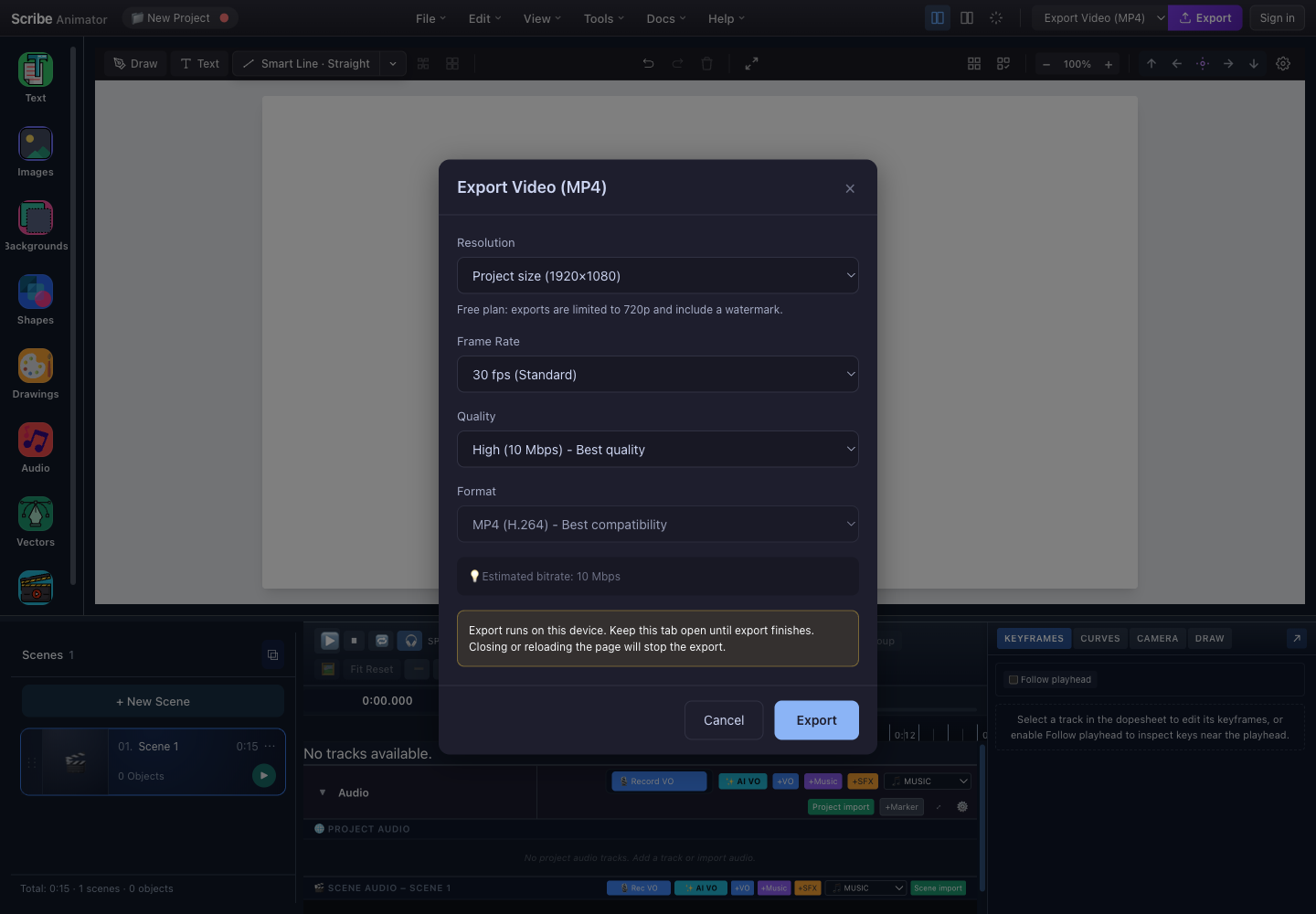
- ResolutionChoose project size, 1080p, 720p, or 480p. The active plan can clamp the final output.
- Frame rateChoose 24, 30, or 60 frames per second.
- QualitySelect the target bitrate: Low, Medium, or High.
- FormatThe current dialog exports MP4 using H.264 for broad playback compatibility.
- Estimated bitrateA quick indication of compression, not the final file size.
- Local-render warningKeep this tab open; navigating away interrupts export.
- ExportStarts rendering with the selected effective settings.
1. Resolution
- Project size uses the project canvas dimensions when the plan and exporter allow them.
- 1080p is a common final delivery size for presentations and full-screen web video.
- 720p is a good test or lightweight delivery size.
- 480p is useful for fast previews and bandwidth-constrained review.
The free plan is limited to 720p and includes a watermark in the current build. If the project is 1920×1080 but the effective output says 1280×720, the plan limit is being applied correctly.
2. Frame rate
- 24 fps gives a film-like cadence and produces fewer frames.
- 30 fps is the best default for most explainers and product demos.
- 60 fps can make fast movement smoother, but roughly doubles the frames compared with 30 fps and increases rendering work.
A higher frame rate cannot repair low-resolution assets or poor animation timing.
3. Quality
| Setting | Target bitrate shown by the editor | Best use |
|---|---|---|
| Low | 2 Mbps | Quick proof or messaging attachment |
| Medium | 5 Mbps | Most web reviews and drafts |
| High | 10 Mbps | Final delivery where text and fine lines must stay crisp |
Quality changes compression. Resolution changes pixel dimensions. Check both.
4. Format and estimate
The current video dialog exposes MP4 (H.264) for compatibility. The bitrate estimate helps compare quality settings, but duration, audio, scene complexity, and encoder behavior affect the final file size.
Export a video step by step
- Select Export Video (MP4) in the top bar if more than one exporter is available.
- Select Export.
- Choose the resolution and read the effective plan note.
- Choose 30 fps unless the destination specifically needs 24 or 60 fps.
- Choose Medium for a draft or High for a final.
- Confirm MP4 (H.264).
- Select Export in the dialog.
- Keep the tab open while the progress phase renders and encodes frames.
- When the completion action appears, download or save the file.
- Play the downloaded file from beginning to end—not only the first scene.
What success looks like
- The progress view completes without an encoder error.
- The downloaded video has the expected dimensions and duration.
- Every scene is visible inside the frame.
- Audio starts at the intended time and remains synchronized.
- Text, thin strokes, and imported images remain readable.
- The last frame is not cut off.
Practical setting recipes
| Destination | Resolution | Frame rate | Quality |
|---|---|---|---|
| Fast internal review | 480p or 720p | 24 or 30 fps | Low |
| Typical web or LMS video | 720p or 1080p | 30 fps | Medium |
| Presentation or product demo | 1080p | 30 fps | High |
| Fast motion that genuinely needs it | 1080p when available | 60 fps | High |
Platform upload services may recompress the video. Keep the original downloaded export.
Export the current scene as SVG
Use the static SVG exporter when you need a resolution-independent still:
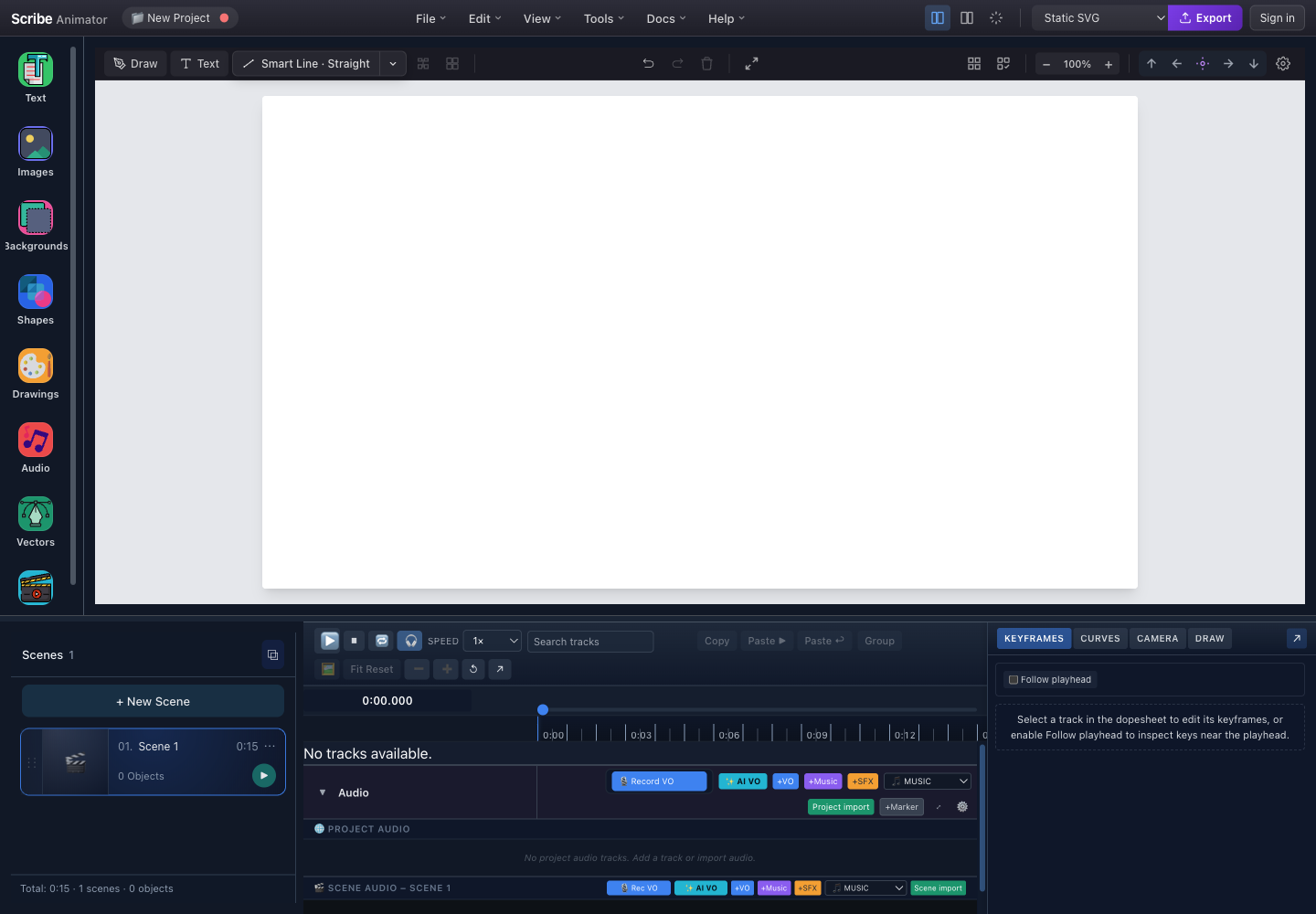
- Exporter selectorStatic SVG changes the output owner from video rendering to the current-scene SVG exporter.
- ExportExports the current scene through the selected Static SVG exporter.
- Move to the scene you want to export.
- Pause playback at the intended state.
- Choose the Static SVG exporter from the export selector.
- Export and open the result in a browser or trusted vector editor.
- Inspect text, strokes, masks, imported imagery, and the viewBox.
An SVG is a still. It does not contain the playable timeline, scene sequence, voiceover, camera move, or drawing schedule. Raster images may be embedded or referenced according to exporter behavior, so verify the SVG on the destination device before removing the source assets.
Create an editable backup
Use File → Export .scribe or the equivalent project-file action for an editable transfer. Store the package separately from the rendered video. Before relying on it:
- Finish the current save operation.
- Export the package.
- Check that it has a
.scribeextension. - Reopen a copy in a test session when the project is important.
- Confirm that locally imported images, audio, and fonts resolve as expected.
Never edit package internals manually unless you are diagnosing a copy and understand the schema.
Limits and safety boundaries
- Export is device-intensive; long projects, high frame rates, large images, and complex paths take longer.
- Web page visibility, browser memory pressure, and encoder support can interrupt a render.
- Native iOS/Android encoding can differ from web encoding.
- Plan limits can reduce effective resolution or add a watermark.
- An export cannot improve the resolution of a blurry source image.
- Static SVG cannot represent animated or audio behavior.
- The exporter does not replace an editable backup.
Troubleshooting
| Symptom | Safest recovery |
|---|---|
| Export stops partway | Keep the app foregrounded, close unrelated heavy apps/tabs, retry once at 720p and 30 fps |
| Output is blank | Return to the scene, stop playback, check object visibility and camera framing, then make a short test |
| Audio is absent | Confirm the track is not muted, the source is hydrated, and playback works before exporting |
| Audio drifts | Test at 30 fps, check scene/audio duration boundaries, and avoid changing the project during export |
| Video is soft | Use a larger allowed resolution and inspect source asset resolution; bitrate alone will not add detail |
| Thin lines break up | Try High quality and inspect the result at 100%; simplify extremely fine geometry if needed |
| Download never appears | Wait for the completion state, allow downloads for the site, and check device storage |
| 1080p becomes 720p | Read the plan note; the current free-plan policy intentionally clamps video to 720p |
The annotated dialog above was captured from the running Scribe Animator editor with browser-based UI review. Labels and plan warnings reflect the verified frontend@2.0.0 UI; encoding availability can still vary by browser and device.